The trees are well into their colour changing and there’s a chill in the air we’ve not felt for a while. It’s definitely october! One of the most beautiful times of year and a time for several rather important jobs in the garden…
As the leaves begin to fall, you can start collecting them to make leafmould. You will need a simple cage container for the leaves – just four stakes for the corners and chicken wire between them as the walls. Around 1m2 is a good size to start with, but you may wish to create a larger cage if you have lots of fallen leaves in your garden.
To make the leafmould, simply rake the leaves and put them into the storage cage. You can chop the leaves up to reduce their volume so that you can fit more in, and this will speed up their breakdown too. Within a year or so you will have high quality organic matter to use in the garden for improving soil, mulching or as a seed compost. If you create your cage on earth, be sure to lay a thick layer of card or membrane at the bottom to suppress any growth coming up into the leafmould. You could even reuse spent compost bags for this.
If you don’t have space for a leafmould cage, or you don’t have many leaves, you can also use a hessian sack, or an old compost bag (or similar) with holes punched in to store the leaves. Prepare the leaves in exactly the same way, dampen the leaves if they are dry and then tie the top loosely. Hang up the sack in a shed or garage, or stack out of sight.
Do be sure however to leave some piles of leaves at the backs of borders and under hedges, as well as stacks of logs and branches to provide habitats for insects, frogs, toads and hedgehogs over winter. These are essential habitats to maintain.
Also, beware of diseased leaves. If you have any plants with fungal diseases (often characterised by spots on the leaves) gather and dispose of the diseased leaves – do not use them to make leafmould as the diseases will survive. Some examples of diseased leaves commonly found in gardens but to avoid using in any sort of compost production are roses with blackspot or hawthorns with leaf spot.
Lastly, not all leaves are equal when it comes to making leafmould. Evergreens and conifers are best added to compost heaps as they will take a long time to break down. Thicker deciduous leaves such as sycamore or horse chestnut are best chopped up or shredded first to speed up their breakdown. Beech, hornbeam and oak are said to be the quickest to break down and make for a very good quality leafmould.
You can start to prune climbing roses from now until late-winter. Now is a good time to check you have enough supports in place for the climbers to be tied to, and to tie in any long whippy branches (if you are not pruning now) to prevent them being damaged by strong winds or heavy rainfall.
Pruning is best done once the leaves have fallen as it will be easier to see what you are dealing with. Any diseased or damaged stems should be removed, as should any crossing stems which will rub together and potentially cause damage to the plant. The main stems should be spread out in an open fan shape and tied in, keeping the side stems as horizontal as possible as this will promote the best growth of flowering shoots next year. The remaining side shoots can be trimmed back to two leaves/nodes.
Check your climbers for any broken or damaged stems. Remove these as this is where disease or rot can set in. Make sure they are well tied in to sturdy supports. This is to provide support to them as we enter the windier months where they could get damaged if they are blown around too much. This will also be good preparation for when they are ready to put on new growth in the spring.
If you are planning to add any new trees, shrubs, hedges or perennials to your garden, now is a great time of year to do this. The ground is still warm but it is also damp which is ideal for new plants to establish in. If you are looking for inspiration, we have written about some of our favourite plants for autumn here.
Now is also a good time to move any existing plants, for the exact same reason that conditions are favourable for plants to establish in new homes. If you are digging plants up to move them, a good rule of thumb is to start digging at the width of the plant visible above the ground, as the rootball will likely be similar or smaller. Try to damage the roots as little as possible by gently digging around them to loosen them in the soil, rather than rocking the plant around too much to break them. There will obviously need to be some disturbance in order to remove the plant, but this is a job best not rushed.
Whether you are planting a new plant or a plant you have moved within your garden, be sure to water it in well (even if it’s due to rain) and water it weekly until we have a decent amount of rainfall. This will give it the best chance of establishing in the new position.
If you have any herbaceous perennials that are getting a bit overcrowded, or too large for their space, now is the time to divide them. Dividing herbaceous perennials such as rudbeckia, hardy geraniums, geums and ornamental grasses shouldn’t be done in the first few years of planting but once every 3 or so years once established. Lift the plant, then use either a garden fork to divide it or two spades back to back for more mature root balls. Voila you now have two plants! You can split these again if they are big enough. This is a great way of getting new plants for free and making sure the plants you have don’t get overcrowded and remain looking their best.
Some perennials will be dying back towards the end of the month and can be cut back and mulched. With the weather still being quite mild this job may become a november one, but it’s worth keeping an eye out. Plants that can be cut back once they have started to fade include nepeta and hardy geraniums – really just those moundy plants which could become a soggy mess over winter. Other plants with taller, more structural stems can be left for winter interest – such as verbena bonariensis, echinacea, sedum, ornamental grasses and phlomis. It’s much more interesting to look at these stems than bare ground, and they provide food for birds and/or shelter for insects over winter. They can be cut down to the ground in early spring once the new growth starts emerging.
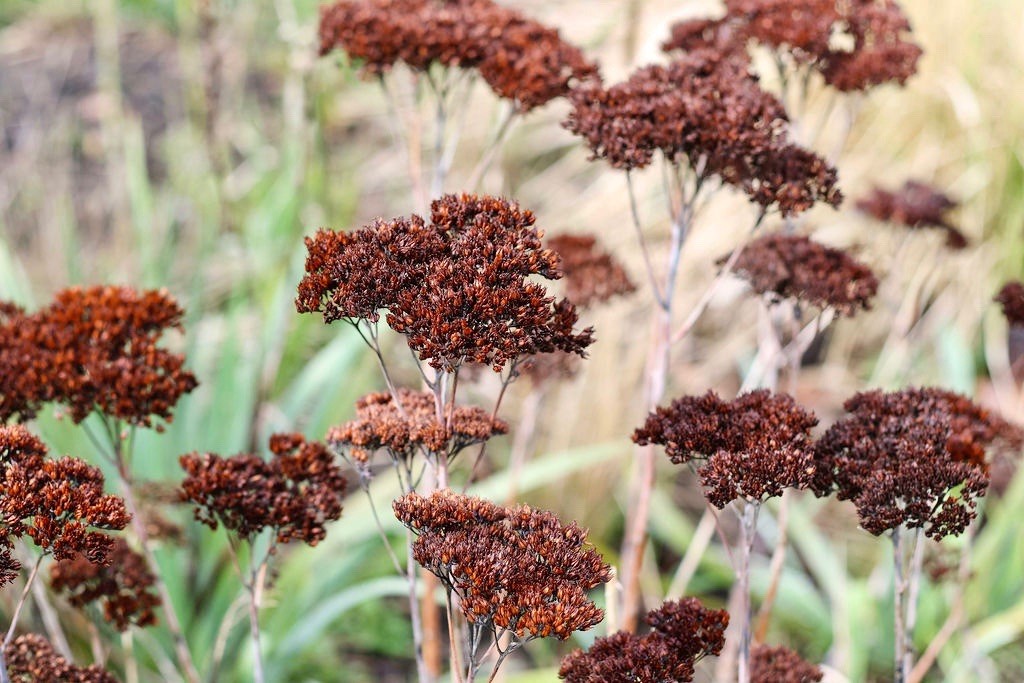
Plants with sturdy seed heads, such as this sedum, are great to leave for winter interest
Penstemons and salvias should be left until spring as this year’s growth will protect the crown of the plant over winter. Note that some salvias aren’t hardy and so if you haven’t already taken cuttings you could still try this now (look for new shoots, without flowers) in case they don’t survive the winter. Or you can always lift and pot them to keep them in a greenhouse or other sheltered spot over winter.
If you have garden pots, it is sensible to raise these off the ground now so that they don’t sit wet if we have a lot of rainfall. You can buy pot feet (both ornamental ones or invisible ones) or use something like bricks to lift them off the floor and allow for water to run through them.
Lawn growth will be slowing so now is a good time to tidy up the lawn. Please note however that it is better for it to be a little on the long side than cut super short! We suggest mowing your lawn on a medium setting as well as aerating it. You can aerate your lawn using a garden fork and pricking it at regular intervals. You can also buy a special tool or shoes to do this too if you so choose. Aerating the lawn will help with compaction and allow nutrition and water to reach lower down.
Now is also probably the last chance before spring to sow grass seed to cover any patches on your lawns.
We hope you get to enjoy doing some of these jobs over the coming weeks!


Gardens by Anna Butterfield offer professional garden and planting design across London and the South East.
Our expert, organic garden care service is available across South East London as well as parts of Kent and Surrey.